
Nairobi National Park wildlife is the reason the park matters. It is not simply a convenient safari stop beside Nairobi. It is a compressed savannah ecosystem where rhinos, lions, buffalo, giraffes, zebras, antelopes, hyenas, birds, reptiles, wetlands, grasslands, and riverine habitats still function under the pressure of a fast-growing city.

KWS lists Nairobi National Park as having 100 mammal species and 500+ migratory and endemic bird species, with animals including buffalo, giraffe, lion, leopard, baboon, zebra, wildebeest, cheetah, black and white rhino, hippo, and crocodile.
What animals are found in Nairobi National Park?
Nairobi National Park has rhinos, lions, buffalo, giraffes, zebras, antelopes, warthogs, ostriches, baboons, vervet monkeys, hippos, crocodiles, hyenas, jackals, leopards, cheetahs, reptiles, amphibians, small mammals, and more than 400 bird species. The park’s animal diversity comes from its habitat mosaic: open plains, wooded grassland, dams, wetlands, riverine edges, rocky gorges, thickets, and dry forest patches.
| Wildlife group | Examples | How visitors should understand them |
|---|---|---|
| Rhinos | Black rhino, white rhino | One of the park’s strongest conservation and safari highlights |
| Large herbivores | Giraffe, buffalo, zebra, eland, hartebeest, impala, gazelles, warthog | The most visible wildlife on many game drives |
| Predators | Lion, leopard, cheetah, hyena, jackal, serval, caracal | Lions and hyenas are realistic; leopards and cheetahs are less predictable |
| Birds | Ostrich, secretarybird, raptors, waterbirds, vultures, migrants | A major wildlife layer, not a side attraction |
| Wetland animals | Hippo, crocodile, frogs, waterbirds, insects | Best around rivers, dams, and Hippo Pools |
| Small mammals | Baboons, vervet monkeys, mongooses, hares, hyraxes, genets, civets, porcupines | Some are common; many are nocturnal or secretive |
| Reptiles and amphibians | Crocodiles, snakes, lizards, skinks, geckos, frogs | Often overlooked but important to the food web |
Which animals are visitors most likely to see?
The animals visitors are most likely to see in Nairobi National Park are giraffes, zebras, buffalo, impalas, gazelles, hartebeest, eland, warthogs, ostriches, baboons, vervet monkeys, rhinos, and many birds. These species use open plains, grassland edges, roadsides, dams, and woodland margins where game-drive vehicles can observe them.

Common or realistic sightings
- Masai giraffe — one of the park’s most visible and photogenic mammals.
- African buffalo — often seen in groups near grassland, water, or thicker cover.
- Plains zebra — common in open grassland and mixed grazing areas.
- Impala, gazelles, eland, and hartebeest — the main antelope layer of the park.
- Common warthog — frequent on short grass, open tracks, and grazing lawns.
- Olive baboon and vervet monkey — common around woodland, roadsides, and picnic areas.
- Ostrich and large birds — easy to see in open country.
- Black and white rhino — realistic with good guiding and enough time.
- Raptors and waterbirds — strong around plains, thermals, dams, and wetland edges.
Which animals are possible but not guaranteed?
The main possible but not guaranteed sightings are lions, hyenas, hippos, crocodiles, jackals, secretary birds, large raptors, cheetahs, and leopards. These animals occur in the park, but they depend more on timing, weather, habitat, recent movement, grass height, and luck.
| Species | Visitor expectation |
|---|---|
| Lion | Realistic, especially early morning, but never guaranteed |
| Hyena | Possible, often better early in the day |
| Hippo and crocodile | More likely if the route includes river-linked areas |
| Leopard | Present but secretive; treat as a bonus sighting |
| Cheetah | Possible but uncommon |
| Secretarybird and raptors | Strong birding targets, but not guaranteed every drive |
Which animals are rare or very elusive?
Rare or difficult sightings include serval, caracal, genet, civet, porcupine, aardwolf, bats, some snakes, and many small nocturnal mammals. Some of these species may not be biologically rare, but they are rarely seen by ordinary daytime visitors because they are nocturnal, solitary, low-density, or associated with thick cover, rocky areas, drainage lines, or quiet grassland edges.
Is Nairobi National Park a Big Five park?
Nairobi National Park is not a full Big Five park because it does not have resident elephants. It has lion, leopard, buffalo, black rhino, and white rhino, but elephants are absent as a resident wild population. The better description is that Nairobi National Park is a Big Four park with exceptional rhino value, real predator presence, strong birding, and accessible plains wildlife.
Why are there no elephants in Nairobi National Park?
Nairobi National Park does not support resident elephant herds because it is small, urban-edged, constrained by infrastructure, and fenced or developed on several sides. Elephants need large ranges, broad seasonal movement, and landscapes where their feeding pressure can be absorbed. Nairobi NP’s present wildlife role is centred more strongly on rhinos, lions, buffalo, giraffes, zebras, antelopes, birds, wetlands, reptiles, and smaller carnivores.
Visitors who want elephants near Nairobi usually pair the park with an elephant-conservation visit, but the national park itself should not be sold as an elephant-viewing destination.
Why are rhinos the signature animals of Nairobi National Park?
Rhinos are the signature animals of Nairobi National Park because the park is one of Kenya’s important rhino sanctuary landscapes. KWS describes Nairobi National Park as one of Kenya’s successful rhino sanctuaries, and the park’s management plan identifies black rhino as a key conservation target.
A rhino sighting here is more than a large-animal moment. It reflects decades of protection, monitoring, anti-poaching investment, habitat management, and public conservation value beside Nairobi.
Can you see both black and white rhinos?
Yes. Nairobi National Park has both black rhinos and white rhinos. White rhinos are generally easier to see because they are grazers and often use more open grassland. Black rhinos are browsers, usually more secretive, and more likely to use thicker vegetation or quieter edges.
| Rhino type | Feeding style | Typical visitor impression |
|---|---|---|
| Black rhino | Browser | More secretive, solitary, often harder to see clearly |
| White rhino | Grazer | More open-country, often easier to observe |
| Both species | Conservation-dependent | Best searched slowly with a knowledgeable guide |
Can you see lions in Nairobi National Park?
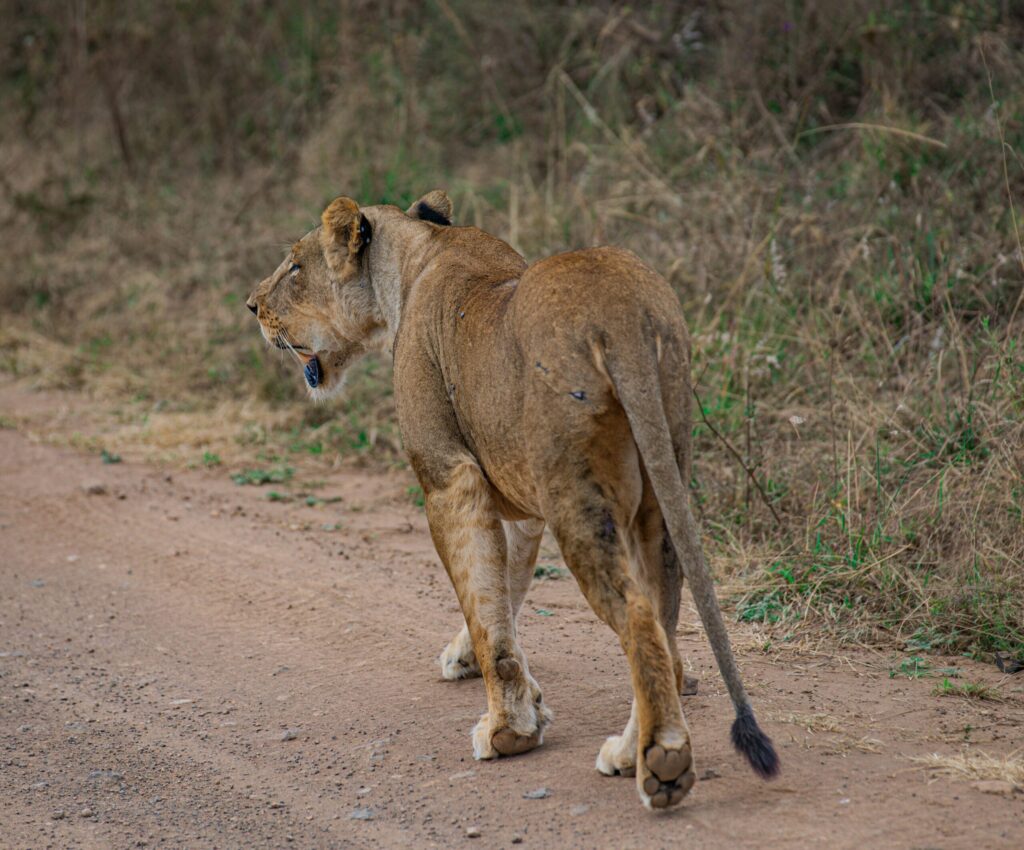
Yes. Lions live in Nairobi National Park, and lion sightings are realistic, especially during early morning game drives. They are not guaranteed. A good guide searches for lions by reading prey behaviour, tracks, alarm calls, shade lines, drainage routes, recent reports, and resting cover.
The park’s management plan treats large carnivores as one of its conservation targets, which shows that predators are not just visitor attractions; they are part of the park’s ecological identity.
Why are lion sightings unpredictable?
- Lions often rest in shade, long grass, or thickets after early morning.
- Prey movement changes their position.
- Heat reduces daytime activity.
- Human disturbance and boundary pressures can alter behaviour.
- A lion may be close but invisible in grass or bush.
Are leopards and cheetahs found in Nairobi National Park?
Leopards and cheetahs occur in Nairobi National Park, but both should be treated as special sightings.
Leopards are secretive, solitary, and often associated with riverine woodland, rocky areas, thickets, and low-light periods. Cheetahs require open-country visibility, prey availability, and low disturbance. Neither species is as reliable as rhinos, giraffes, buffalo, zebras, impalas, gazelles, or ostriches.
Can you see hyenas in Nairobi National Park?
Yes. Spotted hyenas are realistic in Nairobi National Park, especially early in the morning. They may be seen moving after night activity or resting near quiet sections later in the day.
Hyenas are often misunderstood as simple scavengers. In ecological terms, they are major carnivores, bone-crushers, carcass recyclers, lion competitors, and key members of the predator-scavenger system.
What herbivores are found in Nairobi National Park?
Nairobi National Park supports a varied herbivore community, including Masai giraffe, African buffalo, plains zebra, common eland, Coke’s hartebeest, impala, Grant’s gazelle, Thomson’s gazelle, common warthog, hippo, and wildebeest.
These animals are the engine of the park’s food web. They graze, browse, move nutrients, maintain prey availability, shape grass structure, open pathways, and support predators, scavengers, insects, and birds.
Main herbivores and what they reveal
| Herbivore | Ecological role | Visitor note |
|---|---|---|
| Giraffe | Browser of woody vegetation | Often seen against Nairobi’s skyline |
| Buffalo | Heavy grazer/browser | One of the park’s Big Four animals |
| Zebra | Coarse-grass grazer | Common in open grassland |
| Eland | Large browser/grazer | Africa’s largest antelope |
| Hartebeest | Open-plains antelope | Characteristic grassland species |
| Impala | Bush-edge grazer/browser | Common near cover |
| Gazelles | Short-grass grazers | Good indicators of open plains |
| Warthog | Short-grass grazer | Common and easy to watch |
| Hippo | Semi-aquatic grazer | Tied to river-linked habitats |
Why do herbivore declines matter in Nairobi National Park?
Herbivore declines matter because they change the whole ecosystem. Fewer migratory grazers can alter grass height, reduce prey availability, change predator behaviour, affect scavengers, and reshape bird communities.
Long before census reports made it official, people who watched the park regularly could see the plains changing. The old pulse of wildebeest and other migratory herbivores moving between Nairobi National Park and the Athi-Kaputiei plains became weaker as settlement, fencing, infrastructure, and land subdivision closed routes.
Ogutu and colleagues reported that the migratory wildebeest population declined from almost 30,000 in 1978 to around 5,000 at the time of their study, while several other ungulates also declined regionally.
What happened to wildebeest in Nairobi National Park?
Wildebeest still belong to Nairobi National Park’s wildlife story, but they no longer define the park the way they once did. Historically, the park was part of a wider Athi-Kaputiei seasonal movement system. As dispersal land became fenced, subdivided, settled, or developed, wildebeest movement declined sharply.
That decline is one of the clearest warnings that Nairobi National Park cannot be understood as a self-contained island. Its wildlife still depends on ecological processes outside the fence.
What birds can you see in Nairobi National Park?
Nairobi National Park has more than 500 bird species according to KWS, and the park’s Important Bird Area value is part of its wider conservation significance.
Birds in the park include:
- Open-country birds — ostrich, secretarybird, bustards, cranes.
- Raptors — eagles, vultures, hawks, buzzards, kites, falcons, owls.
- Waterbirds — herons, egrets, storks, ibises, ducks, kingfishers, waders.
- Grassland birds — larks, pipits, widowbirds, cisticolas, wheatears.
- Woodland birds — hornbills, barbets, doves, shrikes, starlings, flycatchers.
- Migrants — seasonal Palearctic and intra-African migrants.
Birds are not secondary wildlife. They show how the park is functioning. Raptors reveal prey systems. Vultures reveal carcass ecology. Waterbirds reveal wetland condition. Grassland birds reveal grazing structure and habitat quality.
What reptiles and amphibians occur in Nairobi National Park?
Nairobi National Park reptiles include Nile crocodiles, snakes, monitor lizards, agamas, skinks, geckos, and tortoises. Amphibians occur around dams, seasonal pools, wet grassland, drainage lines, and marshy edges.
| Group | Examples | Where to look |
|---|---|---|
| Crocodiles | Nile crocodile | Rivers, pools, wetland edges |
| Lizards | Agamas, skinks, geckos, monitors | Rocks, sunny edges, picnic areas, woodland margins |
| Snakes | Various grassland, woodland, and wetland species | Rarely seen; usually hidden |
| Amphibians | Frogs and toads | After rain, near pools, dams, and drainage lines |
Amphibians are especially important because they connect water quality, insects, birds, reptiles, and small mammals. In a city-edge park, they are also sensitive indicators of pollution and hydrological change.
What small mammals live in Nairobi National Park?
Small mammals in Nairobi National Park include baboons, vervet monkeys, mongooses, hares, rodents, bats, hyraxes, genets, civets, porcupines, servals, caracals, and other small carnivores.
Some are easy to see. Baboons and vervet monkeys are common around roads, woodland edges, and picnic sites. Others are usually nocturnal or secretive.
Why small mammals matter
- They feed raptors, snakes, jackals, servals, caracals, leopards, and owls.
- They disperse seeds.
- They consume insects.
- They disturb soil.
- They reveal the park’s night ecology.
- They connect grassland, woodland, rocky, and wetland food webs.
Which habitats hold the most wildlife?
Nairobi National Park wildlife is best understood by habitat. A good guide reads the park as a mosaic, not a single grassland.
| Habitat | Wildlife value |
|---|---|
| Open grass plains | Zebras, gazelles, hartebeest, eland, ostriches, secretarybirds, lions, hyenas, raptors |
| Wooded grassland | Giraffes, impalas, buffalo, browsing rhinos, baboons, woodland birds |
| Rhino-use grasslands | Black rhino, white rhino, buffalo, plains game |
| Dams and wetlands | Buffalo, hippos, crocodiles, frogs, waterbirds, kingfishers, raptors |
| Riverine woodland | Monkeys, birds, reptiles, shaded mammals, possible leopard habitat |
| Rocky gorges | Raptors, hyraxes, reptiles, scenic viewing, secretive carnivore possibilities |
| Highland dry forest patches | Woodland birds, primates, small mammals, shaded habitat diversity |
The management plan identifies habitats such as wooded and open grassland, open low shrubland, highland dry forest, river systems, and wetlands as key conservation targets or important ecological features.
What is the best time to see wildlife in Nairobi National Park?
The best time to see wildlife in Nairobi National Park is early morning, especially from park opening through the first few hours of the day.
Morning gives cooler temperatures, softer light, more active birds, better grazing visibility, and stronger chances for lions and hyenas before they rest. Rhinos, giraffes, buffalo, zebras, antelopes, ostriches, and birds are also easier to search for before the heat builds.
Morning vs afternoon wildlife
| Time | Wildlife value |
|---|---|
| Early morning | Best for predators, rhinos, active grazers, bird activity, and photography |
| Late morning | Useful for raptors, dams, slower scanning, and general mammal viewing |
| Midday | Often slower for predators; useful for water points and resting animals |
| Afternoon | Good for rhinos, skyline scenes, birding, water points, and late movement |
| Full day | Best for habitat coverage, second chances, and deeper wildlife interpretation |
Is wildlife better in the dry season or wet season?
Nairobi National Park is worth visiting year-round, but the wildlife experience changes with rain.
- Drier periods can improve visibility because grass may be shorter and animals may concentrate closer to water.
- Wetter periods bring greener landscapes, stronger bird activity, more insects, breeding displays, and richer photography.
- Tall grass after rain can hide smaller animals and make predators harder to see.
- Wet roads can affect route choice, especially in lower or black-cotton-soil areas.
Is a full-day safari better for wildlife?
A full-day safari is better for deeper wildlife coverage. It does not guarantee rare animals, but it gives the guide more time to search multiple habitats, revisit rhino areas, wait at strong sightings, include dams and river edges, and work both morning and afternoon activity windows.
A half-day safari is often enough for first-time visitors who start early. A full day is better for photographers, birders, serious wildlife visitors, families who prefer a slower pace, and anyone who wants to understand the park rather than only see a few headline animals.
What animals are best seen on a half-day safari?
A half-day safari can work well for giraffes, zebras, buffalo, rhinos, warthogs, impalas, gazelles, hartebeest, ostriches, baboons, vervet monkeys, birds, and possible lions or hyenas. The limitation is route coverage. A good half-day drive must stay focused.
What animals are best seen on a full-day safari?
A full-day safari improves opportunities for rhinos, lions, hyenas, hippos, crocodiles, raptors, waterbirds, skyline wildlife scenes, riverine habitats, and broader habitat species. The advantage is not certainty; it is ecological reach.
Is Nairobi National Park good for wildlife photography?
Yes. Nairobi National Park is excellent for wildlife photography because it combines large mammals, rhinos, birds, plains, dams, skyline backgrounds, and accessible game-drive routes.
Strong subjects include:
- Rhinos in open grassland.
- Giraffes against Nairobi’s skyline.
- Buffalo with oxpeckers.
- Zebras and antelopes on the plains.
- Ostriches and secretarybirds.
- Lions if found in open areas.
- Raptors and vultures.
- Waterbirds at dams.
- Warthogs, baboons, and behaviour scenes.
- Wet-season green landscapes.
- Dry-season dust and silhouettes.
A private safari vehicle with a pop-up roof helps because positioning, light, and patience matter more than most visitors realize.
Is Nairobi National Park good for children learning about wildlife?
Yes. Nairobi National Park is excellent for children because it offers real wildlife close to the city without the long travel time of distant parks.
Children can learn:
- The difference between grazers and browsers.
- Why rhinos need protection.
- Why elephants are absent.
- Why predators are not always visible.
- How birds use grasslands, dams, trees, and wetlands differently.
- How a city can threaten and support conservation at the same time.
- Why a national park is not a zoo.
The easiest animals for children to understand are giraffes, rhinos, zebras, buffalo, ostriches, warthogs, baboons, vervet monkeys, antelopes, and large birds.
Are animal sightings guaranteed?
No. Nairobi National Park is a real wildlife landscape, not a controlled animal display. No ethical guide should guarantee lions, leopards, cheetahs, rhinos, or any specific species.
A good guide improves probability by choosing the right time, reading animal behaviour, using local knowledge, checking habitats carefully, and adjusting the route. Wildlife remains free-moving, and that is part of the value of the park.
What if you do not see lions?
A safari can still be excellent without lions. Nairobi National Park can still produce rhinos, giraffes, buffalo, zebras, antelopes, ostriches, warthogs, hyenas, hippos, crocodiles, raptors, waterbirds, skyline scenes, and conservation landmarks.
Lions are exciting, but they are not the whole park. A mature wildlife experience is one where the visitor sees the whole system, not only the headline predator.
Why does the Athi-Kapiti corridor matter for Nairobi National Park animals?
The Athi-Kapiti and Kitengela plains matter because Nairobi National Park is not ecologically complete on its own. WRTI describes the Athi-Kapiti ecosystem as critical ecology for Nairobi National Park and as the only connectivity between Nairobi National Park and the Kitengela-Athi-Kaputiei ecological regions.
This wider landscape affects:
- Wildebeest and zebra movement.
- Predator-prey balance.
- Grassland structure.
- Drought resilience.
- Genetic exchange.
- Seasonal dispersal.
- Long-term wildlife viability.
- Bird communities.
When connectivity narrows, the park becomes more island-like. That changes the way animals move, feed, breed, and survive.
What are the main threats to Nairobi National Park wildlife?
The main threats to Nairobi National Park wildlife are urban expansion, fencing, infrastructure, pollution, invasive species, drought, roads, railways, flight paths, human-wildlife conflict, habitat fragmentation, and loss of dispersal space.
The management plan identifies major issues including wildlife population decline, habitat degradation, human-wildlife conflict, wildlife security, invasive species, pollution, climate change, urbanization, and development pressure around the park.
| Threat | Wildlife effect |
|---|---|
| Urban expansion | Reduces dispersal space and increases edge pressure |
| Fencing and subdivision | Blocks seasonal movement |
| Roads and railways | Fragment habitat and disturb movement |
| Pollution | Affects wetlands, rivers, amphibians, birds, and water quality |
| Invasive species | Alters grassland and woodland structure |
| Drought | Concentrates wildlife and increases stress |
| Human-wildlife conflict | Affects predators and boundary animals |
| Corridor loss | Weakens migration, grazing patterns, and ecosystem resilience |
What is the food web in Nairobi National Park?
Nairobi National Park’s food web begins with grasses, shrubs, trees, wetlands, insects, and aquatic systems. Herbivores feed on plants. Predators feed on herbivores. Scavengers recycle carcasses. Birds, reptiles, amphibians, and small mammals fill the smaller ecological layers.
| Food-web layer | Examples |
|---|---|
| Plants and grasses | Feed zebra, buffalo, warthog, gazelles, hartebeest, eland, white rhino |
| Shrubs and trees | Feed giraffe, impala, black rhino, insects, browsers |
| Large herbivores | Support lions, hyenas, leopards, cheetahs, jackals, vultures |
| Small mammals | Feed raptors, owls, snakes, jackals, servals, caracals |
| Wetlands and rivers | Support fish, frogs, crocodiles, hippos, insects, waterbirds |
| Carcasses | Feed hyenas, vultures, jackals, eagles, insects, microbes |
| Birds | Control insects, scavenge, disperse seeds, and signal habitat condition |
This is why Nairobi National Park wildlife should not be reduced to a checklist. The animals matter because they form relationships.
What endangered or threatened wildlife occurs in Nairobi National Park?
The most important threatened wildlife values include rhinos, large carnivores, threatened raptors, vultures, cranes, and habitat-dependent species linked to grassland, wetland, and savannah systems. The management plan places black rhino, large carnivores, migratory species, grasslands, shrublands, dry forest, rivers, and wetlands within the park’s conservation priorities.
For visitors, this means a Nairobi NP safari is also a conservation experience. You are not only seeing animals; you are seeing species and habitats that require active protection to survive beside a major city.
Which animals should first-time visitors focus on?
First-time visitors should focus on rhinos, giraffes, buffalo, zebras, lions if possible, ostriches, antelopes, warthogs, birds, hippos, crocodiles, and skyline wildlife scenes.
That gives a better experience than chasing only one animal. Nairobi NP is most rewarding when seen as a whole landscape: rhino sanctuary, predator system, herbivore community, birding site, wetland refuge, and conservation boundary beside Nairobi.
Which animals should photographers focus on?
Photographers should focus on rhinos, giraffes, buffalo, zebras, ostriches, antelopes, birds, lions if found, skyline scenes, and behaviour moments.
Best photographic themes include:
- Giraffes and skyline.
- Rhinos in grassland.
- Buffalo with oxpeckers.
- Ostriches on open plains.
- Raptors and vultures.
- Waterbirds at dams.
- Lions in early light.
- Wet-season greenery.
- Dry-season dust and silhouettes.
- Small behaviour scenes near tracks and water.
Which animals should birders focus on?
Birders should focus on ostriches, secretarybirds, raptors, vultures, bustards, cranes, waterbirds, kingfishers, grassland birds, woodland-edge birds, and migrants.
A birding route should include open plains, dams, wetland edges, riverine woodland, rocky areas, and woodland margins. Binoculars are essential.
Which animals should families look for?
Families usually enjoy large, distinctive, easy-to-see animals:
- Giraffes.
- Rhinos.
- Zebras.
- Buffalo.
- Ostriches.
- Warthogs.
- Baboons.
- Vervet monkeys.
- Gazelles and impalas.
- Hippos and crocodiles if the route includes suitable water areas.
- Large birds such as secretarybirds, cranes, storks, and raptors.
These animals make the park understandable for children because each has a clear shape, behaviour, or conservation story.
What is the best way to see wildlife in Nairobi National Park?
The best way to see wildlife in Nairobi National Park is an early morning guided game drive in a proper safari vehicle, with enough time for route flexibility.
For better sightings:
- Start early.
- Use a knowledgeable guide.
- Give rhino areas time.
- Treat lions as possible, not promised.
- Include open plains, dams, and river-linked areas.
- Carry binoculars.
- Avoid rushing from one area to another.
- Watch animal behaviour, not only animal names.
- Ask the guide to explain habitats and conservation context.
- Keep expectations realistic.
What is the deepest wildlife lesson of Nairobi National Park?
The deepest wildlife lesson of Nairobi National Park is that wild animals can still survive beside a city, but not without space, protection, and ecological connection.
The park still has rhinos, lions, buffalo, giraffes, zebras, birds, wetlands, reptiles, small mammals, and a working savannah food web. But the old movement routes have narrowed. The wildebeest decline, corridor pressure, human-wildlife conflict, and habitat change show that Nairobi NP is not only a safari destination. It is a living test of whether a modern city can keep a wild ecosystem alive beside it.
A rhino grazing below the skyline, a giraffe crossing open grassland, a lion resting in shade, a secretarybird walking through the plains, or a crocodile lying near a river is not just an animal sighting. It is evidence that Nairobi National Park is still functioning — and a reminder that its future depends on what happens beyond the fence as much as what happens inside the park.